Bone Health
Calcium Absorption: The Critical pH Factor as We Age
Calcium absorption sounds technical, but the idea is actually very simple: your body can’t use calcium unless it first dissolves it. And whether that happens efficiently depends in part on something most people rarely think about — stomach acid.
If you’ve ever wondered why different calcium supplements exist, or why one form may be recommended over another, the answer often comes down to pH — especially as the body changes with age.
Let’s walk through this clearly and simply.

What Is pH — and Why Does It Matter?
pH is a measure of acidity. Your stomach is naturally very acidic, and that acidity plays an essential role in digestion.
It doesn’t just break down food — it helps dissolve minerals like calcium into tiny charged particles called calcium ions (Ca²⁺). Those ions are what your body can absorb in the small intestine.
If a calcium supplement doesn’t dissolve well in the stomach, less of it may be available for proper calcium absorption.
It’s also important to clarify: calcium supplements do not meaningfully change your body’s overall pH. Blood pH is tightly regulated. What matters here is the acidity inside the stomach — where dissolution begins.
How Stomach Acid Changes With Age
In early adulthood, stomach acid production is typically strong and efficient. Over time, however, acid production may gradually decline. This becomes more common after age 50 and is also seen in people who use acid-reducing medications.
Lower stomach acid (hypochlorhydria) isn’t just about indigestion — it also plays a role in how well nutrients like calcium dissolve and become available for absorption. Without sufficient acidity, some calcium forms may not dissolve fully before moving into the intestine, which could reduce the effectiveness of the supplement or dietary calcium.
All of this helps explain why conditions like osteoporosis become more common with age — it’s not just about how much calcium you eat but how effectively your body can use it.
That’s why the form of calcium becomes increasingly important over time. As stomach acid changes, the efficiency of calcium absorption can change as well.
Is This You?
- Over age 50
- Taking acid-reducing medications
- Experiencing more digestive sensitivity than you used to
If so, the form of calcium you choose may matter more than you realize. As stomach acid changes, some calcium types dissolve less efficiently — which can influence how much your body ultimately absorbs.
Comparing Calcium Types — Through the Lens of Aging Digestion
As we age, two realities often overlap:
- Digestive acidity may decline.
- Calcium needs may increase.
This combination makes the characteristics of each calcium form more relevant.
1️⃣ Calcium Carbonate
- High percentage of elemental calcium
- Cost-effective
- Best taken with meals
Calcium carbonate provides a high amount of calcium in a relatively small tablet. For younger adults with strong stomach acid, it can dissolve effectively.
However, because it relies heavily on acidity to break down, its performance may become less predictable when stomach acid decreases. What worked well at 35 may not behave the same at 65. That shift can directly influence long-term calcium absorption as digestion evolves.
The high calcium density is attractive — but dependence on strong acid can make it less ideal as digestive physiology changes.
2️⃣ Standard Algae Calcium
Many algae-based calcium supplements are derived from red marine algae and are naturally rich in calcium carbonate.
Although plant-derived, they often behave similarly to traditional carbonate in terms of acid dependence. The algae source may provide trace minerals, but the dissolution characteristics are often comparable to carbonate.
For individuals with robust stomach acid, this may not present a concern. But as acidity declines with age, these forms can face similar challenges. In those situations, calcium absorption may depend more heavily on how well the supplement dissolves.
The source is natural — the chemistry is still important.
3️⃣ Calcium Citrate
- Lower elemental calcium per tablet
- Less dependent on stomach acid
- Flexible dosing (with or without food)
Calcium citrate dissolves more easily and does not rely as strongly on gastric acidity. That makes it a dependable option when acid levels are lower. Because it dissolves readily, it can help support steadier calcium absorption in those conditions.
However, it contains less elemental calcium per tablet compared to carbonate forms.
After age 50, daily calcium requirements often increase. When each tablet provides less usable calcium, it may require:
- More pills per day
- Larger serving sizes
- Greater long-term cost
So while citrate offers reliable dissolution, the lower calcium density per tablet can make it less convenient when needs rise with age.
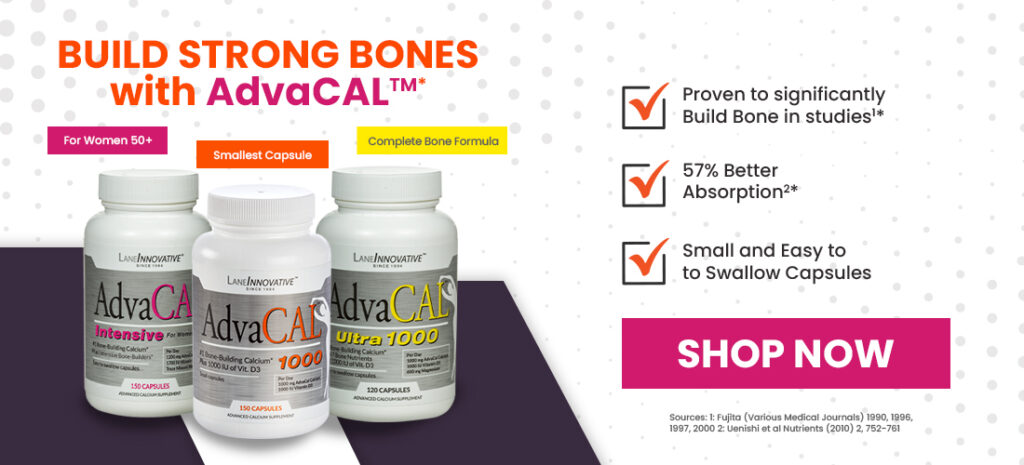
4️⃣ Active Absorbable Algal Calcium (AAACa)
AAACa was developed with these digestive realities in mind.
Produced through a specialized process described by Dr. Takuo Fujita, AAACa is structured to enhance solubility and availability. Instead of depending heavily on high stomach acidity to break it down, it is designed to dissolve readily and release calcium ions efficiently across a broader pH range.*
That distinction becomes increasingly meaningful as digestion changes.
. By enhancing solubility, AAACa is structured to help maintain consistent calcium absorption even as stomach acidity shifts.*
If acidity is strong, AAACa performs well.
If acidity is moderate or reduced, it remains available.*
Unlike calcium citrate, it maintains meaningful elemental calcium density.
Unlike traditional carbonate or standard algae calcium, it does not rely as heavily on high acid levels to become usable.*
In practical terms, it offers balance:
- Solubility*
- Usable calcium content*
- Practical dosing*
- Compatibility with age-related digestive changes*
That balance is what quietly sets it apart.
Why Balance Matters After 50
As digestion changes, the ideal calcium supplement:
✔ Dissolves efficiently
✔ Delivers meaningful calcium per serving
✔ Performs consistently even if stomach acid declines
A form that combines solubility with practical calcium density may offer more predictable support over time.
When evaluating options, it helps to consider how each form may affect overall calcium absorption over time.
A Side-by-Side Perspective
Calcium Type | Acid Dependence* | Calcium Density* | Practical Fit With Aging |
Calcium Carbonate | High | High | May be less predictable as acid declines |
Standard Algae Calcium | Moderate to High | Moderate to High | Similar considerations as carbonate |
Calcium Citrate | Low | Lower | Reliable dissolution but requires more tablets |
AAACa | Low to Moderate | Meaningful | Designed for steady availability across changing digestion* |
The Practical Takeaway
When digestion is strong and steady, most calcium forms can work well.
But over time, the body changes. Acid production may decline. Calcium needs may increase. Convenience matters more. Consistency matters more.
Carbonate offers density but depends heavily on acid.
Citrate offers independence from acid but requires more tablets.
Standard algae calcium often behaves like carbonate.
AAACa bridges those differences — combining algae origin with enhanced solubility and practical calcium density.*
And when thinking long-term about calcium absorption, especially after 50, that steady performance becomes increasingly valuable.*
Because ultimately, it isn’t about how much calcium you take.
It’s about how much your body can actually use.
And that ultimately determines the efficiency of calcium absorption.
Like? Share with Your Friends!